Linear search is dead. Master the data-mapping frameworks required to place your brand at the center of generative AI retrieval loops.
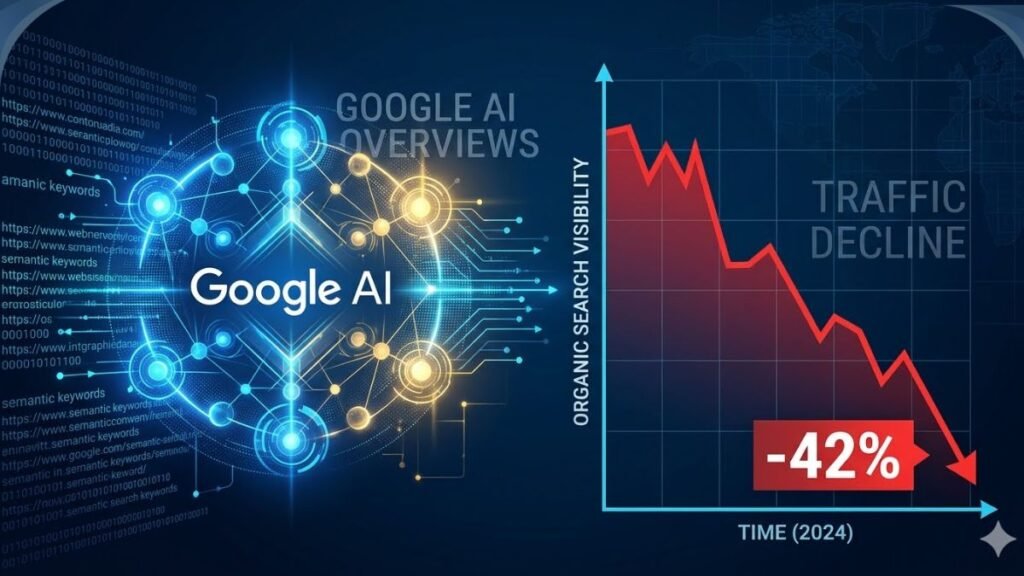
Google is fundamentally restructuring the physics of the internet. The rollout of AI Overviews at the top of search result pages means users no longer need to click through to your website to get their answers. Google’s generative engine simply scrapes, synthesizes, and displays the information right on the main interface, keeping users trapped inside its own ecosystem.
The human cost. For independent creators and legacy newsrooms alike, this is not just a minor algorithm update—it is an existential crisis. Years of careful optimization and investments in high-quality content are being wiped out overnight as organic referral pipelines dry up. If your digital business relies entirely on informational search traffic, you are essentially building a house on a foundation of melting ice.
Inside the Numbers: How Bad is the Traffic Bleed?
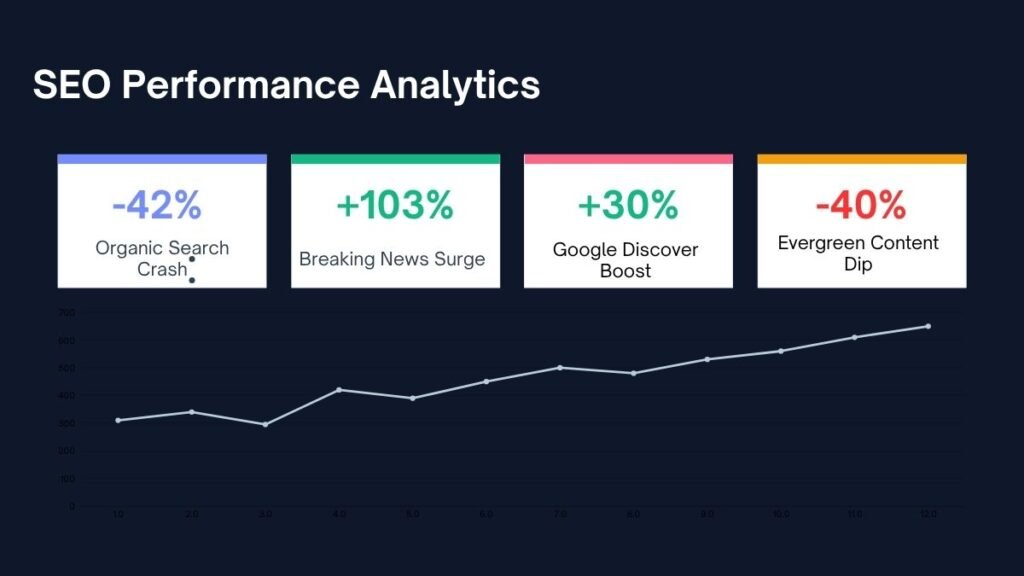
A groundbreaking industry report from Define Media Group analyzed a massive portfolio of major digital publishers to track exactly how AI summaries affect human clicks. The data confirms that traditional organic search clicks plummeted by 42% following the widespread integration of AI Overviews.
Before the AI expansion, publishers safely coasted on an average of 1.7 billion clicks per quarter. Immediately following the launch, traffic dropped 16% and completely failed to recover. By the close of 2025, this initial traffic leak escalated into a devastating 42% structural deficit for traditional publishers.
How are different content types surviving this shift? The damage is highly uneven. Standard informational articles and long-standing “evergreen” guides have taken the biggest hit, dropping roughly 40%. Because these topics deal with static facts, Google’s LLM can easily summarize them without a human click.
| Search Surface & Content Type | Traffic Impact Performance | Primary Driver of Change |
| Traditional Organic Search | 📉 42% Decrease | AI overviews occupying prime screen space. |
| Evergreen / Informational Content | 📉 40% Decrease | Zero-click searches answer queries instantly. |
| Breaking News Content | 📈 103% Increase | Top Stories carousels bypassing AI generation. |
| Google Discover Feed | 📈 30% Increase | Algorithmic push toward user-interest mapping. |
The Breaking News Paradox: Why Real-Time Media is Exploding
The counter-trend. While general informational sites are bleeding out, real-time breaking news content has emerged as an absolute powerhouse, exploding by 103% over the exact same period.
Why does generative AI fail to capture real-time developments? Generative AI breaks down at the speed of news. Because unfolding political shifts and global events lack a historical training footprint, LLMs cannot synthesize updates safely, prompting Google to favor human journalism over ungrounded AI guesswork.
To protect its search accuracy, Google only triggers AI Overviews on roughly 15% of news-related queries. For the remaining 85%, Google aggressively relies on its classic Top Stories carousel, sending massive, direct pipelines of human readers straight to authoritative publisher URLs.
Google Discover: The New Monopoly on Web Traffic
The mobile pivot. With traditional desktop search traffic fading, Google Discover has officially taken the throne as the primary traffic generation engine for modern publishers. Discover traffic grew a staggering 30% across the board last year, often matching or entirely eclipsing standard web search volumes.
Discover operates on an entirely different mental model. Instead of waiting for a user to type a specific query into a search box, Discover proactively pushes highly visual, personalized content cards directly onto a user’s mobile homepage based on their explicit interests and browsing histories.
Adapting Your SEO Strategy to the Generative Era
How can I make my website show up in Google AI Overviews? To win visibility inside the AI summary box, you must optimize specifically for AI indexation rather than raw human clicks. This means structuring your web pages with explicit, highly semantic headers, answering specific user questions directly within your introductory sentences, and providing clear entity relationships that an LLM can easily map.
How do I optimize content to trigger the Google Discover feed? Cracking the Discover feed requires shifting from passive indexing to active audience captivation. Winning this real estate hinges on a strict three-tier protocol: leading with high-quality, vivid visual assets, crafting evocative titles that trigger mobile click-through rates naturally, and reinforcing explicit authorship signals to satisfy Google’s trust algorithms.
The tactical roadmap. Moving forward, the digital publishers who survive will change how they deploy resources.
- Defund Synthetic Real Estate: Halt financial allocation toward low-intent explainer blogs and standard encyclopedic content, as these static layouts are now automatically weaponized by LLMs to fulfill zero-click search intents.
- Monetize Non-Replicable Insights: Architect your core content engine around proprietary corporate datasets, primary-source investigative reporting, and raw field intelligence to generate a high “information gain” footprint that forces AI engines to reference your brand entity.
- De-Risk the Distribution Pipeline: Neutralize systemic platform dependence by migrating transient search traffic into owned, first-party ecosystems—such as authenticated newsletter networks and private digital forums—shielding your baseline revenue from generative volatility.