
Bullets to Paragraph Converter
Transform your bullet points into professional, well-structured paragraphs with our AI-powered conversion tool. Perfect for reports, essays, and professional documents.
📝 Input Bullet Points
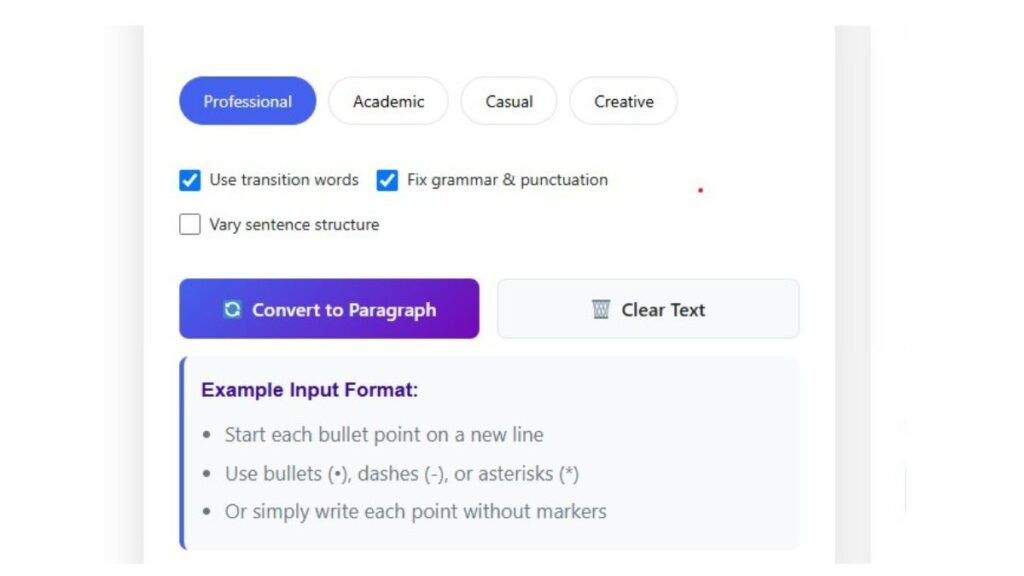
Example Input Format:
- Start each bullet point on a new line
- Use bullets (•), dashes (-), or asterisks (*)
- Or simply write each point without markers
📄 Converted Paragraph
Converting your bullet points…
AI-Powered Conversion
Advanced algorithms transform your bullet points into natural, flowing paragraphs with appropriate transitions.
Multiple Writing Styles
Choose from professional, academic, casual, or creative tones to match your specific needs.
Real-Time Processing
See your paragraph take shape instantly as you make changes to your bullet points.
Quality Analysis
Get readability scores and other metrics to ensure your paragraph meets quality standards.
Formatting Options
Customize the output with transition words, grammar correction, and varied sentence structure.
Export Capabilities
Easily copy your converted text or download it as a file for use in other applications.
Clear formatting, zero friction, and absolute accuracy for modern creators.
Resolving Architectural Asymmetry in Creative Information Processing Digital media publishers, academic investigators, and enterprise workflow architects continually face critical friction when normalizing fragmented, non-linear brainstorming data into unified operational assets. Reconciling the logical distance between isolated concept pointers and syntactically balanced text layout arrays is a core structural challenge across automated content supply chains.
AI Zilla Tech’s new free online bullet-to-paragraph converter completely revolutionizes this entire content creation process. Built to eliminate technical delays, this zero-friction utility converts messy outlines into structured paragraphs instantly without requiring a login or a subscription.
Why it matters. In today’s fast-moving digital publishing world, speed and clear content structure dictate your search engine visibility. If you’re targeting global markets or specific professional sectors in the USA, manual rewriting destroys your creative momentum. This platform solves that exact problem by automating your drafting pipeline while protecting natural readability.
Moving Beyond Raw Outlines to Fluid Copy
Modern web platforms demand structured readability. Why Linear Narrative Structures Dictate Mobile Engagement Although fragmented lists serve as efficient frameworks during initial data ingestion, complex technical concepts require the continuity of structural prose to preserve human cognitive engagement. When digital assets retain a disjointed outline structure, mobile users experience reading friction, which triggers sudden drops in dwell-time performance metrics within core analytics engines. In what ways does automated list transformation reduce editorial overhead? By using specialized textual synthesis, a writer can drop rough notes into the workspace and generate polished executive summaries in a single click. This frictionless framework is perfect for digital publishers managing daily writing deadlines and technical teams building clean internal documentation.
The human impact. This shifts writing tools away from restrictive software paywalls and turns them into accessible resources. It allows student researchers, independent bloggers, and fast-moving writing teams to build professional prose without managing complex software accounts or dealing with hidden data caps.
The Core Technical Logic of Text Reconstruction
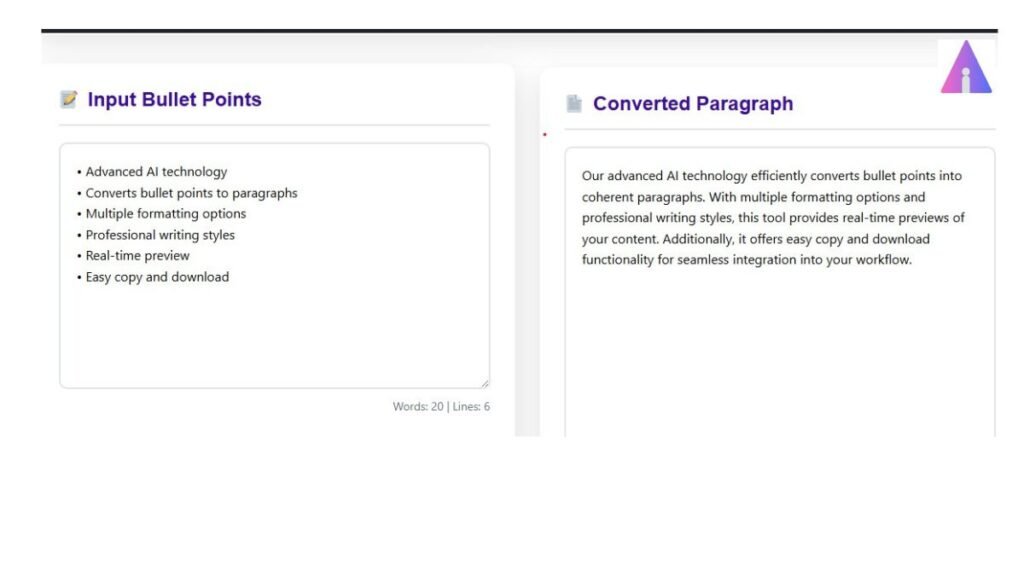
Behind its clean and minimalist interface, the underlying software logic processes multiple text data points simultaneously. Standard text mergers simply string sentences together with basic spaces, which usually creates choppy text or bad grammar. This advanced system uses contextual parsing filters to clean up formatting issues before rebuilding the paragraphs.
The platform automatically converts your list into a structured data array. It analyzes the raw context of each bullet point, applies the tone rules you chose, and adds proper transition markers smoothly. This structure ensures that your output text reads naturally and holds high topical authority across different platforms.
Feature Comparison: Refining Your Prose Style
To build high-performance content, a writer must control structural tone and word choice. The table below highlights how the application of different linguistic adjustments alters text structure to meet specific publication standards.
| Processing Mode | Core Editorial Purpose | Before vs. After Transformation |
| Professional Setting | Ideal for official reports and whitepapers. | Changes fragmented target goals into an executive business summary. |
| Academic Framework | Designed for research essays and thesis papers. | Converts observational study notes into formal argument blocks. |
| Creative Execution | Built for storytelling and narrative blogs. | Transforms raw descriptive words into rich, engaging story setups. |
| Transition Inclusion | Adds cohesive flow between distinct points. | Links separated ideas with smooth connectors like “furthermore” or “consequently.” |
| Grammar Correction | Fixes syntax errors instantly. | Cleans up broken list phrases into complete, structured sentences. |
Why Text Readability Dictates Organic Search Rankings
Search engine scrapers programmatically scan semantic distribution curves and lexical structures to judge real topical authority. When digital layouts display thin data sets or flat bullet strings, algorithmic quality layers immediately flag the text framework as repetitive or low-effort data.
Why Do Modern Search Engines Demand Automated Synthesis? True optimization relies on creating natural human sentence patterns that algorithmic crawlers read easily. When you turn lists into flowing paragraphs, you build a stronger keyword structure that avoids keyword-stuffing penalties while satisfying modern mobile search intent.
Pro tip. When processing outlines for American web audiences, use the varied sentence structure toggle. This breaks up monotonous text patterns and significantly improves your user dwell-time metrics.
Simple Integration for Diverse Writing Demands
Content teams can deploy this flexible utility across various stages of their text pipeline. Because the application runs entirely in your web browser without tracking cookies, it operates as a secure, fast workspace for sensitive draft ideas.
- Blog Optimization: Writers drop rough interview notes directly into the processing engine to build comprehensive article drafts quickly.
- Academic Summaries: Students paste unstructured lecture bullets to generate well-formed study guides and essay body blocks.
- Marketing Copy: Marketers turn a simple list of product features into high-converting copy without losing the core message.
- Email Formatting: Teams process rough talking points into formal, professional outreach messages in seconds.
Future-Proofing Content for Algorithmic Search
Algorithmic search updates now prioritize content clarity over keyword stuffing, making text readability the definitive metric for audience reach. Messy layouts and confusing sentence fragments only frustrate visitors, driving down your conversion rates. By utilizing a real-time text reconstruction framework, writers can quickly build clean, impactful copy that meets both user needs and modern programmatic standards.
The big picture. Dismantling Operational Friction in Content Optimization Pipelines
Unrestricted data access to real-time formatting utilities is a core prerequisite for modern digital publishing. By removing mandatory subscription funnels and background tracking scripts, open-access text diagnostics allow digital media teams to spend less time managing software and redirect their energy entirely into editorial refinement.
Does this tool automatically fix writing grammar?
Yes, our advanced text processing features include automatic grammar, punctuation correction, and varied sentence structure filters to ensure highly readable output paragraphs.
Is the AI Zilla Tech Bullets to Paragraph Converter free?
Yes, this online converter utility is completely free to use with zero limitations, no usage caps, and absolutely no registration or login required.
How to change structured outlines into fluid paragraphs?
You can change bullets to a paragraph instantly by pasting your outline into the AI Zilla Tech converter, choosing your preferred writing tone (professional, academic, casual, or creative), toggling transition options, and clicking ‘Convert to Paragraph.’