An advanced editorial framework for merging automated asset scaling with genuine domain expertise, engineered to dominate destination search query blocks, behavioral content streams, and generative answer engines.
Google has officially reconfigured the rules of digital real estate. In 2026, the old playbook of generating thousands of raw AI articles and expecting them to rank is entirely dead. Search engines have evolved into highly sophisticated intent engines driven by advanced multi-modal models.
The Commodity Trap. While the marginal cost of multi-modal asset creation has effectively plummeted to absolute zero, the financial and strategic premium required to capture organic user visibility has peaked [The-Zero-Cost-Content-Paradox]. Modern enterprise publishers have moved past the era of competing against human industry peers—they are now actively engineering algorithms to survive an unceasing, synthetic content deluge.
To survive this landscape, marketers must shift from mass production to algorithmic governance.
Publishing unedited AI content today guarantees a swift ticket to Google’s “Helpful Content” filter penalty. However, when paired with robust editorial frameworks and deep human verification, AI tools can become your greatest scaling asset.
The 2026 Core Ranking Mechanics: What Changed?
The Tri-Platform Search Ecosystem. Organic visibility is no longer a centralized mechanism; it is a fragmented operational war fought across three distinct digital domains. Traffic acquisition requires independent optimization matrices tailored for classic indexed search blocks, user-specific predictive feeds, and synthesized conversational response nodes.
Google’s Triple-Threat Evaluation
Traditional Ranking
Information Gain Metric
Focuses on unique value and depth of content compared to existing web results.
Discover Feed
Predictive Engagement
Targets user interests proactively based on past behavior and trend matching.
AI Overviews
Synthesis & Direct Proof
Extracts direct answers with verifiable citations for complex user queries.
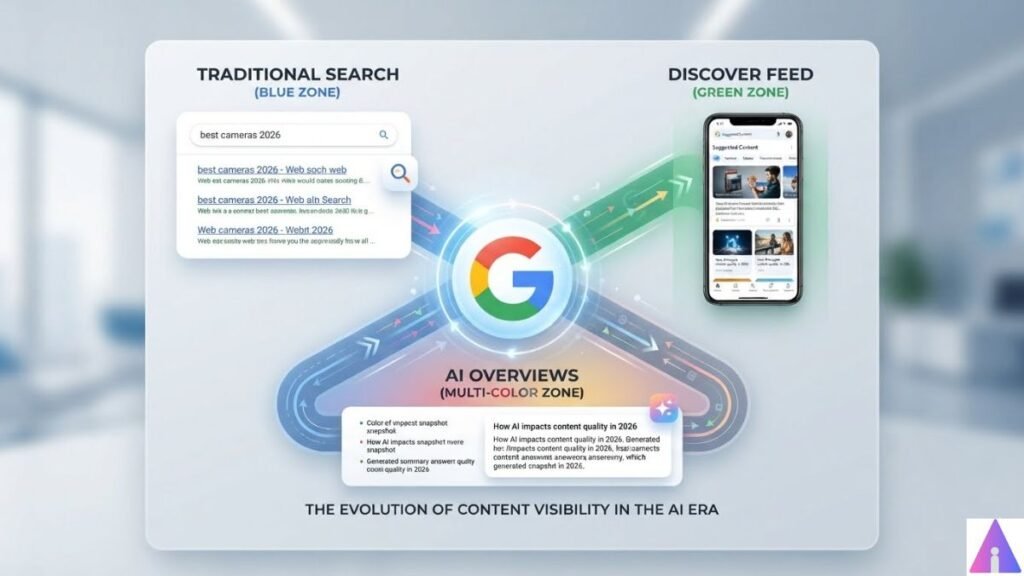
Why it matters. The Information Gain Imperative. Google’s modern ranking engine computes a strict “Information Gain” metric for every indexed URL. When an AI-assisted draft merely rehashes existing SERP components without introducing exclusive datasets, field telemetry, or distinct editorial stances, it triggers algorithmic suppression. The core system rewards digital assets that seed the web with unmapped entities, contrarian analytical vectors, and unreplicable human testing.
Decoding Algorithmic Content Diagnostics. If search platforms claim neutrality toward the method of production, how do automated filters isolate machine-generated text? Quality evaluation engines bypass traditional watermarking or signature lookups entirely. Instead, they scan for structural stagnation—specifically tracking a deficit in cognitive variance, missing semantic layers, and the monotonic sentence architectures native to unrefined large language model (LLM) processing.
Transforming Raw AI Text into Search Gold
The Editorial Mandate. Evading algorithmic filters requires content teams to pivot from superficial proofreading to active structural architecture. Architecting Algorithmic Immunity. The Structural Shift. To thrive in today’s digital real estate, publishers must deploy a rigorous editing matrix that thoroughly reshapes the baseline architecture of raw AI drafts. Simply clean phrasing is no longer enough; long-term organic visibility depends on breaking the predictable mathematical sequence of automated text to restore authentic human cadence.
| Optimization Layer | Legacy Method (Pre-2026) | Modern Framework (2026) |
| Data Enrichment | Pulling statistics from generic web searches | Inserting first-party telemetry, CRM data, or unique case studies |
| Tone & Style | Accepting default conversational LLM outputs | Injecting brand-specific idioms, active voice, and variable sentence lengths |
| EEAT Signals | Adding a generic author bio box | Embedding quotes, multimedia evidence, and verified expert credentials |
| Structural Design | Linear text blocks with standard H2/H3 layouts | Fragmented, scannable hybrid structures built for mobile behavior |
The key risk. Relying on basic AI prompting creates a flat, predictable reading experience. To break this monotony, force your AI tools to write with high textual burstiness. Mix short, five-word punchy sentences with longer, deeply analytical clauses.
Injecting E-E-A-T and Information Gain at Scale
Experience, Expertise, Authoritativeness, and Trustworthiness (E-E-A-T) are no longer passive design elements—they are the active ranking pillars of the current search era.
How can a brand demonstrate authentic expertise when utilizing automated drafting tools? The secret lies in decoupling the research and validation phases from the actual writing phase.
Phase 1: Cultivating Your Exclusive Intelligence Asset
Before letting an AI write a single sentence, you must feed it a custom context packet. This packet should contain:
- Internal data points and customer survey results.
- Direct quotes from your internal subject matter experts.
- Unique contrarian viewpoints that challenge standard industry assumptions.
Phase 2: Sourcing and Entity Mapping
The Entity Architecture. The Connected Web. Next-generation search engines process web pages by mapping relationships between recognized, real-world concepts rather than just reading keywords. Citing Trust Elements. When your draft incorporates references to a market authority or an established enterprise, integrating explicit hyperlinks to their official digital profiles is a non-negotiable step. This linking architecture functions as undeniable proof of credibility, proving to search quality evaluators that your editorial output is backed by recognized, real-world source data.
Pro tip. Use explicit schema markup to map these relationships clearly for search crawlers. Tell the algorithm exactly who wrote the piece, who verified the facts, and what primary data sources were used to construct the argument.
The Detection Dilemma: Identification and Humanization Frameworks
As search engines deploy more sophisticated parsing models, the technical line between raw synthetic text and human composition has become a critical battleground for webmasters.
How do algorithms accurately detect AI-written content in the wild? Ad networks and search quality systems analyze text patterns rather than looking for a digital signature. The Mathematics of Machine Prose. Because Large Language Models function as probability engines that calculate the next sequential token, their compositional outputs remain mathematically predictable. Modern parsing arrays evaluate text density across twin algorithmic vectors: perplexity profiles (the statistical anomaly score of word associations) and structural burstiness (the systemic volatility of sentence length and dynamic cadence). Unmodified synthetic layouts routinely present suppressed perplexity values and uniform burstiness markers—instantly signaling a complete deficit of organic human cadence.
AI Detection Engine Analytics
Low Perplexity
Predictive, generic word selections
Text is highly predictable to language models. It lacks the unique vocabulary changes and creative phrasing typically found in human writing.
Low Burstiness
Identical, monotonic sentence structures
It drops the structural elasticity, dynamic phrasing shifts, and rhythmic burstiness native to authentic human prose.
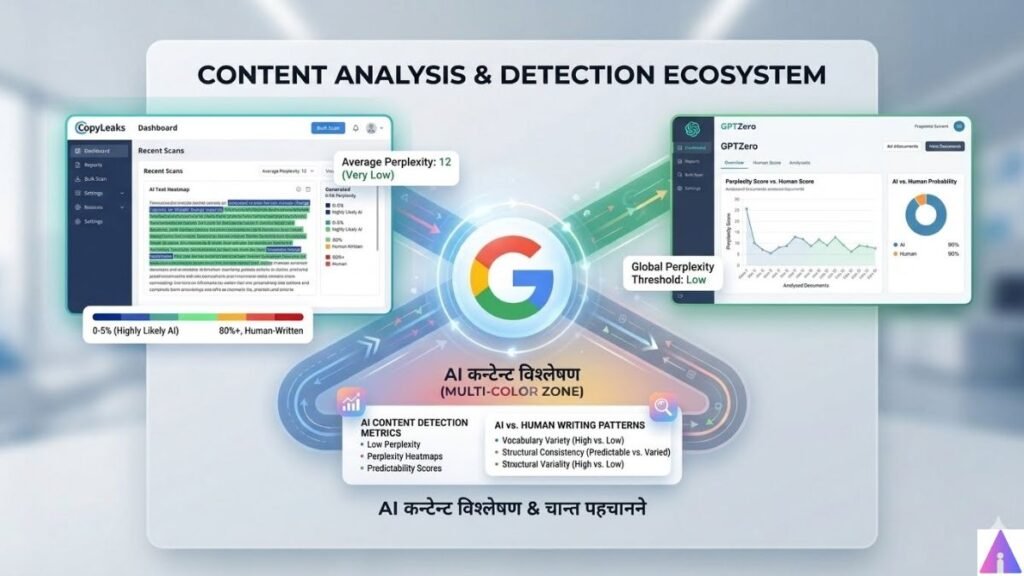
How to detect AI-written content online for free? Webmasters can scan their copy using free tools like Copyleaks and GPTZero to identify linguistic predictability before indexing. Free versions of these scanners provide heatmaps revealing low-perplexity zones where phrases read too flawlessly. Manual Syntactic Inspection. To identify machine signatures natively without software assistance, evaluate the draft for predictable connective tissues—specifically tracking overused transitional anchors like “furthermore” or “in conclusion”—while auditing the prose for a high density of passive voice constructions that flatten narrative urgency.
How to humanize AI written content for free? Bypassing algorithmic filters requires manual structural disruption and precise prompt engineering to break the mathematical predictability of LLMs without buying costly software.
- Engineer Rhythmic Contrast: Force high structural variance. Intertwine sharp, five-word declarations directly with elaborate, multi-layered descriptive arguments to emulate organic speech patterns.
- Exorcise Machine Semantics: Aggressively eliminate signature large language model (LLM) footprints. Purge artificial transition markers such as “Furthermore,” “In conclusion,” “It is important to note,” and “Delve deep” from your documentation.
- Embed Empirical Telemetry: Ground your copy in exclusive proprietary data, field experiments, or granular brand case studies. Automated models lack the capacity to counterfeit genuine, localized human friction without direct injection.
Optimizing for the Triple Crown: Search, Discover, and AI Overviews
Sustaining organic audience acquisition requires engineering content that simultaneously satisfies three completely fragmented user engagement models.
1. Traditional Search: Intent Matching
Ensure your content directly answers the explicit query within the first two paragraphs. Do not bury the lead. Use structured tables and comparative matrices midway through the article to satisfy high-density information requirements instantly.
2. Google Discover: The Predictive Hook
Discover relies heavily on user behavior, topical interests, and visual engagement. To trigger the Discover algorithm:
- Lead with High-Stakes Narrative Hooks: Establish immediate contextual tension in your introduction. Frame the core concept around imminent industry disruption or direct operational threats to instantly capture passive scrolling attention.
- Deploy High-Density Asset Libraries: Embed custom, multi-layered visual assets or proprietary info schematics. Ensure every visual component supports a max-image-preview:large configuration with a minimum 1200px footprint to optimize full-bleed feed delivery.
- Engineer Non-Leaking Curiosity Matrices: Construct high-interest title strings that promise absolute conceptual resolution without relying on sensationalized curiosity gaps or clickbait syntax.
3. AI Overviews: Securing the Citation
To get your website cited as a primary source inside Google’s conversational answers, structure your content to match how LLMs extract facts. Use clear, declarative “is” or “because” statements immediately following high-intent questions within your text.
Future-Proofing Your Organic Strategy
The intersection of artificial intelligence and search engine optimization is shifting constantly. What works today will inevitably be refined tomorrow as ad networks and search platforms deploy updated core models.
The big picture. Building Trust Through Reference Mapping. Search crawlers evaluate the integrity of your content by checking how well it aligns with known industry frameworks. To clear these relational quality checks, every reference to a professional authority or market leader should be anchored with clear outbound links to authoritative digital registries. This practice proves to the algorithm that your brand is actively participating in a credible, peer-reviewed knowledge network. Marketing teams that treat automated engines as an absolute surrogate for human critical thinking will inevitably trigger systemic traffic collapse across their core channels.