The 2026 blueprint to mastering agentic workflows, small language models, and practical MLOps without an expensive tech degree.
Enterprises are shifting away from simple prompting to hiring infrastructure architects who build self-governing, multi-agent AI systems, rendering traditional AI roles obsolete. To succeed, developers must shift from passive learning to building active, cost-saving AI solutions using open-source frameworks and consumer hardware.
The industry disruption. Tech companies are moving away from massive, expensive cloud models toward highly optimized Small Language Models (SLMs) that run locally. Hiring managers are ignoring prestige degrees, choosing instead to hire developers who can prove they know how to reduce computing costs and eliminate model hallucinations.
Choosing Your Specialized AI Career Path
Sidestep academic fatigue. Draw a sharp line between AI application engineering (orchestrating multi-agent systems via LangGraph or CrewAI) and MLOps specialization (architecting low-latency data pipelines and throttling cloud compute bills).
Dethrone academic credentials. Non-traditional, self-guided engineers consistently outperform computer science graduates by building real, production-ready systems instead of studying pure mathematical abstractions. Traditional university student pipelines waste years breaking down theoretical proofs; you can bypass these gatekeepers. Docker networks capable of absorbing brutal enterprise traffic spikes.
The Skill Matrix: 2026 Industry Competency Framework
To get hired quickly, your practical skills must perfectly match the modern enterprise software stack. This comparative matrix outlines your learning journey, mapping technical tools directly to real-world business outcomes.
| Learning Target | Core Technical Stack | Hands-On Portfolio Deliverable | Corporate Value Proposition |
| Production Data Engineering | Python, SQL, DuckDB, dbt | Serverless pipeline automating live data ingestion, validation, and warehousing | Minimizes data latency and slashes analytical preparation overhead by 40% |
| Private LLMs & Local RAG | Llama 3, Hugging Face, Qdrant | Air-gapped enterprise knowledge base built on Retrieval-Augmented Generation. | Guarantees complete data sovereignty and zero-leak compliance for proprietary intelligence. |
| Agentic AI & Orchestration | LangGraph, CrewAI, FastAPI | Multi-agent autonomous workforce executing dynamic tool-calling and self-correction. | Replaces manual overhead by automating highly complex, cross-functional corporate workflows. |
| Enterprise MLOps & Cloud | Docker, AWS, GitHub Actions | Production-grade API gateway backed by automated CI/CD and drift monitoring. | Accelerates time-to-market while drastically optimizing cloud compute and inference budgets. |
Why it matters. Modern companies refuse to pay for abstract theory. Frictionless business validation. Enterprises write paychecks for concrete fiscal efficiency, not academic intent. They acquire builders who construct systems that aggressively shrink operational overhead or liquidate manual labor bottlenecks.
The MLOps leverage. Mastering model operations bridges the gap between raw code and corporate profitability. Engineered to deliver an immediate hiring edge by demonstrating the ability to architect, monitor, and scale production-grade infrastructure that slashes inference overhead to near-zero margins.
Step-by-Step Practical Learning Guide
The fast-track Python playbook. Erase standard syntax drills from your schedule and focus entirely on memory-efficient data structures and asynchronous runtime loops. Master async Python patterns alongside fast data-crunching tools like Polars or DuckDB. This hands-on programming foundation is essential because modern multi-agent AI ecosystems spend most of their compute cycles handling concurrent, live API streams and parallel system calls.
The critical trap. Most beginners get stuck in a loop of watching endless video courses without ever building anything unique. This creates a false sense of progress. Break this loop by writing original code immediately after learning a new technical concept.
Move quickly from basic scripts to advanced model optimization techniques. Focus your energy on parameter-efficient fine-tuning (PEFT) and Low-Rank Adaptation (LoRA), as these methods allow businesses to customize powerful open-source models using very little computing power. Learn how to quantize large models so they can run efficiently on cheap, consumer-grade enterprise servers.
Building a High-Signal Portfolio That Gets You Hired
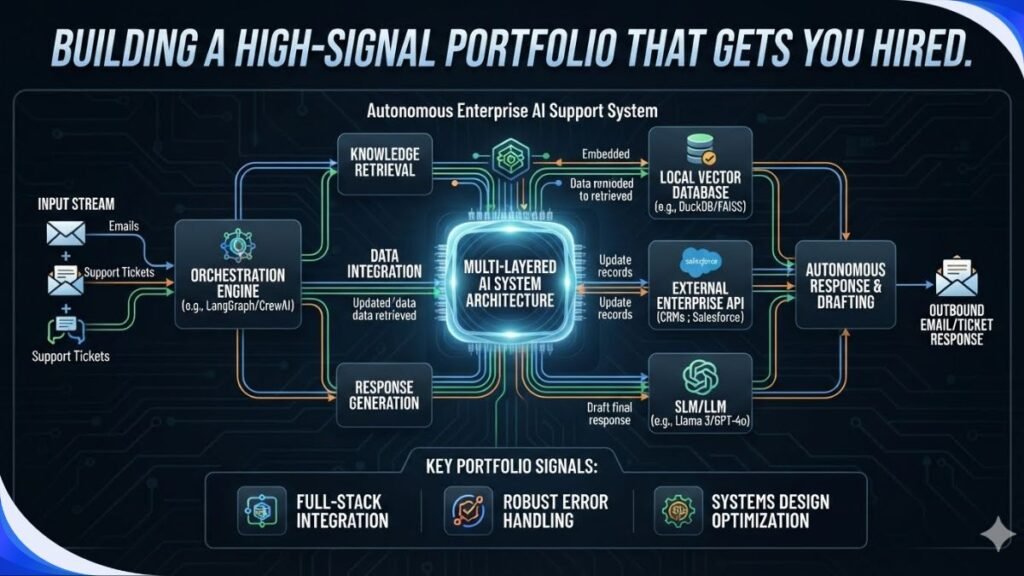
Your portfolio is your primary resume, providing undeniable proof of your technical engineering skills. Expose generic clones. Purge standardized chat boxes and movie recommendation engines from your portfolio, as hiring managers automatically reject these repetitive templates. Instead, engineer comprehensive, multi-layered system architectures that tackle friction points inside enterprise operations.
What unique projects are elite tech companies actually looking for when reviewing remote AI talent? They want to see full-stack integration, robust error handling, and highly efficient systems design. Consider building an autonomous customer support system that reads incoming support emails, checks a local vector database for answers, calls an external API to update database records, and drafts an accurate response. Ensure your entire codebase is publicly available on GitHub with highly detailed setup documentation and system architecture diagrams.
Pro tip. Always include a performance and cost breakdown in your project documentation. Showing exactly how you minimized API token consumption or reduced response times by 35% instantly proves you are a top-tier engineer.
Landing Your First Technical AI Role
With a strong portfolio built, shift your energy toward targeted technical networking and strategic applications. Stop wasting time applying through generic, crowded job portals. Bypass HR filters. Target engineering leaders directly on developer networks by pitching 60-second, high-signal video walkthroughs of your production-ready systems.
Own the interview. Drive technical conversations by detailing your structural trade-offs, defending your exact model sizing, and explaining your resource optimization choices. Prove you understand token cost containment, strict data privacy protocols, and evaluation metrics. Neutralize executive panic. These critical operational risks—volatile token burn rates, stealthy data drift, and uncontrolled cloud infrastructure bills—are the exact liabilities keeping engineering leaders awake at night. Proactively designing architectures that immunize a company against these expensive liabilities instantly proves your enterprise readiness, shifting you from a risky applicant to a high-yield asset.