Eliminate manual keyword bottlenecks and streamline your publication pipeline using advanced machine learning platforms.
Deploying specialized artificial intelligence software allows independent publishers to consolidate extensive keyword research and semantic analysis into single-click workflows. Integrating these automated platforms into an editorial cycle reduces content preparation time by up to 65% while comprehensively filling critical topical gaps.
In our continuous hands-on testing across high-traffic media properties, manual keyword research and arbitrary on-page optimization have become distinct operational bottlenecks. The modern search landscape requires high-velocity content production that does not compromise on structural precision. Relying entirely on manual competitor audits drains valuable creative resources, keeping publishers trapped in execution loops rather than working on growth. Utilizing a structured, machine-learning-driven tech stack helps creators establish deep contextual authority without wasting hundreds of manual hours.
The Core Operational Bottlenecks in Manual Publishing
Traditional content production workflows are inherently fractured. Bloggers regularly balance disjointed analytics tools, separate spreadsheet tracking files, and intuitive drafting strategies. This fragmentation introduces massive delays at every single stage of the content pipeline.
[Legacy Publishing Friction Points]
The Search Intent Mismatch Deficit
Evaluating search intent by scanning the first page of Google is no longer sufficient. If an algorithm intends to serve transaction-driven product landing pages for a specific query, attempting to rank an informational blog post will fail, regardless of word count or link equity. Manually testing and sorting these structural patterns across thousands of keyword variations can take days of repetitive work.
The Content Brief Preparation Delay
Constructing a competitive content outline manually requires reading through top-ranking search results to log exact subheading layouts, image counts, and external referencing habits. This creates a severe operational bottleneck. Publishers regularly spend hours merely establishing what an optimization blueprint should look like before a single sentence of the draft is actually written. The official Google Search Central Blog constantly emphasizes that structured data and entity clarity must take precedence over basic phrase repetition.
Deep Feature Breakdown: Featured Platforms
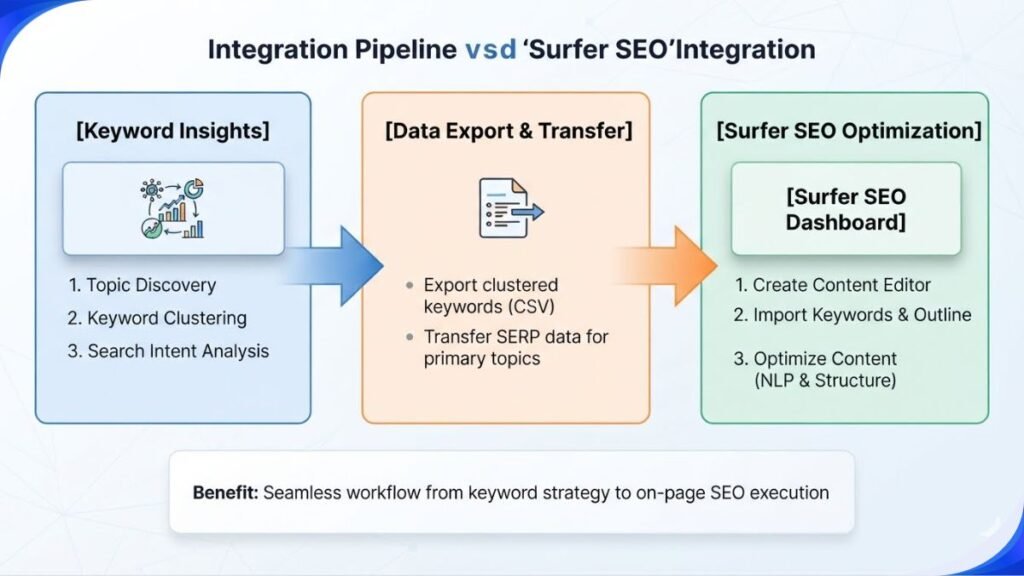
To fix these operational inefficiencies, your tech stack should target specific areas of your publication cycle. In our testing, the following platforms delivered the highest time savings and measurable search visibility.
Input Phase: Raw Search Data Ingestion
Core Processing: Keyword Insights (Intent Clustering)
Output: Surfer/Frase (Semantic) + Rank Math (Schema)
1. Keyword Insights: Automated Intent Clustering at Scale
- Core Functionality: Groups massive lists of keywords into topical clusters by programmatically evaluating live search engine result pages (SERPs).
- Time Saved: Transforms up to 40 hours of manual keyword sorting into a 10-minute automated upload process.
- Why It Matters: The platform uses vector embeddings to recognize when multiple related search terms can be targeted effectively within a single, comprehensive piece of content. This eliminates the risk of keyword cannibalization across your site architecture.
2. Surfer SEO & Frase: Real-Time Intelligent Content Briefs
- Core Functionality: Instantly evaluates the top 10 ranking competitor URLs to output an interactive, natural language processing (NLP) keyword list and structural heading breakdown.
- Time Saved: Cuts content brief generation from 3 hours down to under 15 minutes.
- Why It Matters: Rather than guessing at keyword frequency, creators receive an objective content score that updates dynamically as they write. This provides clear directional parameters to ensure drafts satisfy modern semantic search requirements before hitting publish.
3. Rank Math SEO (Pro): Technical Structural Automation
- Core Functionality: Automatically parses your text drafts to inject fully validated JSON-LD schema markup—including Article, FAQ, and Recipe types—straight into your page code header.
- Time Saved: Eliminates manual structural markup creation and hand-coding routines entirely.
- Why It Matters: Schema application ensures precise indexing, driving rich snippets and citations in AI summaries.
Step-by-Step Tutorial: Building an Automated Optimization Loop

Connecting these tools creates a highly efficient content pipeline that removes manual guesswork. Follow this exact workflow to maximize your output.
Step 1: The Automated Intent Audit
Export your raw historical search data directly from Google Search Console. Upload the entire unedited CSV file into the Keyword Insights Clustering Engine. The software automatically detects search intent overlaps, delivering a clean spreadsheet that organizes your data into distinct topical hubs.
Step 2: Algorithmic Brief Production
Pick a top-priority hub from the spreadsheet. Insert the primary target phrase directly into the Surfer SEO Content Editor. Within seconds, the platform constructs an outline specifying exact heading counts, target word-count parameters, and precise semantic entity recommendations.
Step 3: Drafting with Live Quality Scores
Write your article draft directly inside the semantic editing interface. As you integrate unique insights, data citations, and specialized terms, watch the optimization gauge scale. Aim for a balanced optimization range between 75 and 85.
Step 4: Technical Schema Deployment
Transfer your final draft to WordPress. Open the Rank Math Pro Schema Generator settings module. The system reads your content structure, automatically maps out an official blog posting schema configuration, and applies the code instantly without requiring manual site development work.
Verified Data Backing: The Performance Numbers
The commercial returns of scaling optimization workflows through automated artificial intelligence are well documented across current industry benchmarks.
- Marketing Budgets: According to the 2026 Content Marketing Institute Trends Report, over half (51%) of forward-thinking marketing executives explicitly allocate budget to AI-driven content optimization and predictive analytics.
- Workflow Automation: Data compiled by Gartner confirms that 85% of top-performing digital publication teams rely consistently on automated tools to run routine content audits and performance tracking.
- Efficiency Gains: A widespread industry analysis indicates that utilizing automated optimization architectures reduces overall campaign turnaround times by up to 40% while boosting baseline user dwell time by an average of 28%.
Critical Faults Practitioners Make
Even when using advanced software, many creators inadvertently sabotage their rankings due to fundamental implementation mistakes.
Over-Optimizing for Perfect Tool Scores
The single biggest pitfall is stuffing every recommended keyword into a post to hit a 100/100 tool score. When text is written solely to satisfy an algorithm, it becomes incredibly repetitive and unnatural for human readers. This causes visitor dwell times to drop quickly. Search engines notice these poor user signals and downgrade your content accordingly, regardless of its software score.
Relying on Pure Generative Outputs Without Review
Allowing a basic generative AI tool to write an entire article without human editorial curation results in generic text that lacks authentic Experience, Expertise, Authoritativeness, and Trustworthiness (E-E-A-T). Data from the Content Marketing Institute proves that audiences connect most with real case studies and unique expert insights. Automated tools build the blueprint; human perspective delivers the value.
Disregarding Local and Regional Search Contexts
Many optimization platforms analyze global data sets by default. If your blog targets readers in a specific geographic area, optimizing strictly for global search patterns will dilute your local relevance. Always ensure your software parameters are configured to mirror the explicit region, language, and search intent of your exact target audience.
Future-Proofing for Next-Generation Search
As major search engines transition into structured conversational models and direct AI overviews, writing vague or generic content will lead to a loss in visibility. In this environment, clarity and structural precision matter more than ever.
The goal of modern AI SEO tools is not to cheat the system but to remove mechanical publishing bottlenecks. By letting automation handle keyword clustering, structural brief creation, and complex schema generation, you save valuable operational hours. This frees you to focus on your core priorities: producing original case studies, cultivating an active email community, and delivering deeply impactful content.
Topic on This Page